What a recent closure can teach us about unresolved problems, daily responsibility, and the trust families place in childcare providers
A recent childcare closure in Liverpool, New York, attracted attention for all the reasons these stories usually do. State regulators suspended the license of a KinderCare location after repeated violations and additional findings during a recent inspection. Public reporting described a substantial history of corrected and uncorrected violations, while New York’s official childcare database now lists the center’s license as suspended.
Headlines like this naturally alarm parents. They can also make responsible childcare providers uncomfortable because they know how quickly the public can interpret a licensing story as proof that an entire program—or even the profession itself—cannot be trusted.
But there is an important lesson beneath the headline:
A childcare center does not accumulate a serious compliance history in a single afternoon, and an inspection does not create the conditions it discovers. It makes those conditions visible.
That distinction matters.
What families are really entrusting to a provider
Every morning, parents walk into childcare programs carrying the most precious people in their lives. They may bring backpacks, medications, lunch containers, enrollment forms, and extra clothes—but those are not what they are truly handing over.
They are entrusting another person with their child. Whether the question is spoken or not, every family is asking:
Will my child be safe, protected, and cared for while I am away?
Every provider accepts that responsibility when the child enters their care. This is the starting point of the WizHippo Manifesto: childcare begins with a promise, and everything else exists to help providers keep it.
Licensing requirements, staff training, background checks, supervision rules, emergency plans, health records, medication authorizations, and inspections are not separate from that promise. They are among the systems used to put it into practice.
Problems usually develop gradually
Most childcare programs do not suddenly stop caring about children, what usually happens is far less dramatic.
A staff member’s certification approaches expiration. A child’s health form is never returned. A medication authorization becomes outdated. A fire drill is completed but not documented. A corrective action is discussed but not followed through. A staffing change affects classroom ratios. A maintenance concern is temporarily addressed but never fully resolved.
Meanwhile, the director is managing employees, responding to parents, covering classrooms, handling enrollment, solving billing problems, ordering supplies, and trying to preserve the quality of the program.
One unresolved issue becomes two. A temporary workaround lasts longer than intended. Something that was going to be fixed on Friday is pushed into the following week. Because nothing visibly harmful happened yesterday, the urgency begins to fade.
This is how operational risk often grows: not through one dramatic decision, but through a series of conditions that remain unresolved.
That does not mean all violations are minor or equal. Some findings concern documentation; others may directly affect children’s supervision, health, treatment, or physical safety. New York law permits an immediate suspension when regulators find that public health or a child’s safety or welfare is in imminent danger.
The lesson is not that serious findings should be minimized. It is that they must be noticed, corrected, and verified before they are allowed to become part of normal operations.
Compliance is not separate from care
For many providers, the word compliance immediately brings paperwork to mind. That reaction is understandable. Childcare programs manage an enormous volume of forms, records, dates, signatures, certificates, logs, and policies.
But the form is not the purpose.
A CPR certificate represents a person prepared to respond during an emergency. A background clearance represents a safeguard around who may have access to children. A medication authorization represents clear permission and instructions for caring for a child’s health needs. A fire-drill log represents a team that has practiced how to respond when time matters.
The document is evidence. The protection it represents is the reason it exists.
As our manifesto explains, licensing requirements preserve lessons that the childcare profession and society have learned—sometimes after children were placed at risk. The intention is not simply to generate records. It is to reduce the chance that preventable harm will happen again.
That is why compliance should not be treated as an administrative activity performed only for regulators. It is part of the daily practice of care.
What an inspection actually verifies
An inspector may review forms, walk through classrooms, observe staff, evaluate the facility, and examine records. But the deeper question is not simply, “Does this center have paperwork?”
The deeper question is:
Can families trust that this program consistently follows the practices intended to protect children?
The paperwork provides evidence. The inspection provides independent verification. The purpose is protection.
This is also why successful inspections generate so much emotion. Providers celebrate zero deficiencies, thank their teams, praise their staff, and tell families how proud they are. They are not celebrating a collection of completed forms. They are celebrating outside confirmation that their daily work, systems, and attention have met the standards expected of them.
An inspection does not create that commitment. At its best, it recognizes and verifies it.
Trust is earned between inspections
Most parents will never examine every staff certificate or emergency record. They may never see a daily safety checklist, training tracker, corrective-action plan, or medication log.
Yet their confidence depends on those systems working.
Trust is earned when staff qualifications remain current, when required records are complete, when ratios are maintained, when concerns are corrected, and when leaders know what requires attention before a regulator—or a harmful event—brings it to light.
The WizHippo Belief System describes this relationship clearly:
Childcare begins with a promise. That promise creates responsibility. Responsibility requires consistent daily care. Compliance demonstrates that the responsibility is being practiced. Inspections verify the commitment, and families experience the result as trust.
Passing an inspection, therefore, is not the entire goal. It is one point of confirmation along a much longer journey.
What providers can learn from this closure
The purpose of discussing this case should not be to attack one center, speculate about individual employees, or turn another community’s disruption into a marketing opportunity.
- It should prompt every childcare leader to ask practical questions:
- Do we clearly know which issues remain unresolved?
- Does every corrective action have an owner and a deadline?
- Can we see what has changed since our last review?
- Are temporary solutions quietly becoming permanent?
- When something is corrected, do we verify that the correction is complete?
- Would our team recognize a pattern before it became a crisis?
These are not questions to ask only when an inspection notice arrives. They are leadership questions. They belong in the daily operation of a childcare program.
For the affected families, a sudden closure creates an immediate crisis. Parents must find new care, adjust work schedules, explain the disruption to their children, and decide where they can safely place their trust next. The operational consequences extend far beyond the provider and the licensing agency.
That is why unresolved compliance problems are never “just paperwork.”
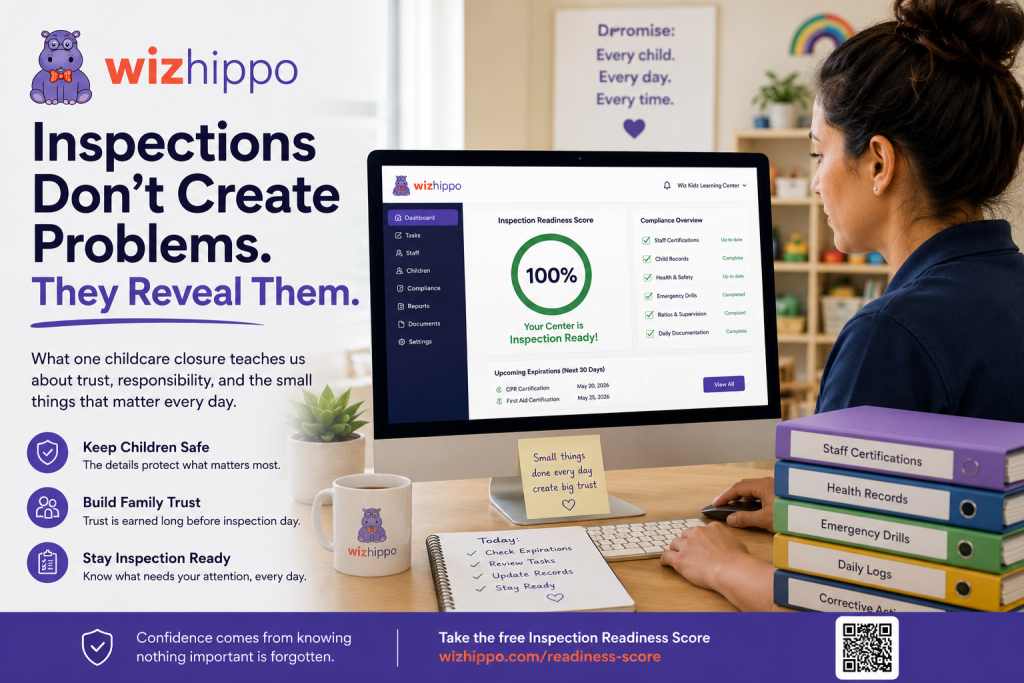
Inspection readiness is a daily practice
The strongest childcare programs do not remain ready because they expect an inspector tomorrow. They remain ready because children are present today.
They understand that safety depends on consistent attention, that trust depends on evidence, and that small unresolved issues deserve action before they combine into larger risks.
At WizHippo, we believe every child deserves a provider who never stops paying attention to what keeps them safe. We also believe providers deserve better visibility into the records, responsibilities, expirations, and follow-up items that can otherwise disappear into the demands of a busy day.
Our purpose is not to make providers afraid of inspections. It is to help childcare professionals remain aware of what needs attention while there is still time to address it.
Because inspections should not be the first moment a center discovers what has been happening inside its own operation.
They should confirm what the provider already knows:
The promise made to families is being kept.