
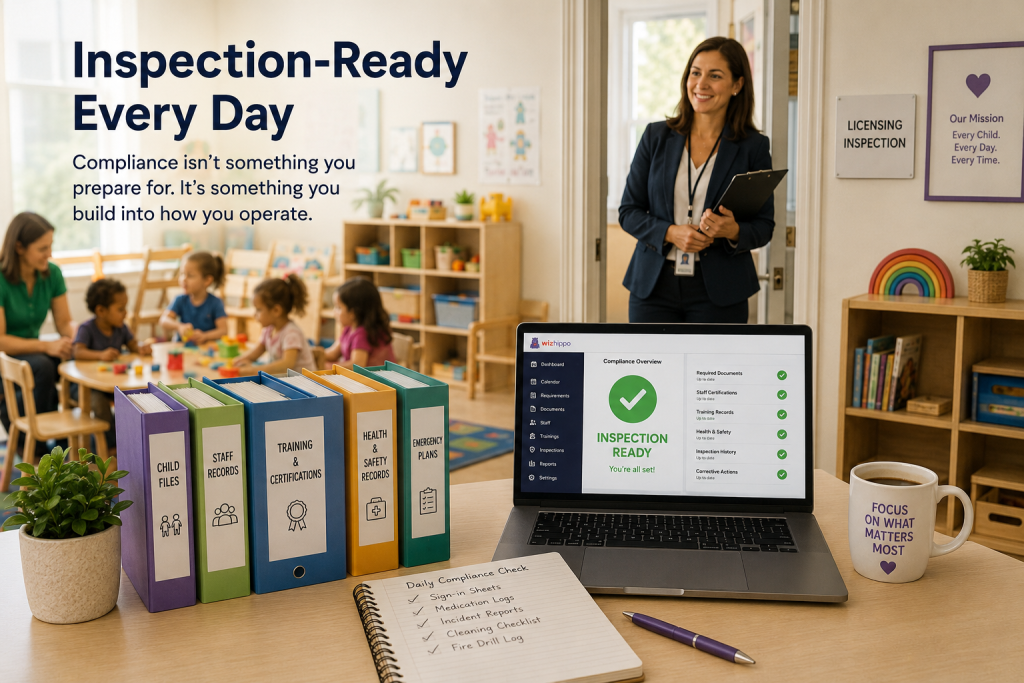
A licensing inspector can walk through the door on what feels like a completely ordinary morning. Children are arriving, teachers are getting settled into their classrooms, breakfast is underway, and a parent may be waiting at the front desk with a question. Then licensing arrives, and the inspection begins.
There is no extra day to go through staff files or double-check training records. You don’t get an hour to find a missing document or make sure that CPR certification you meant to check is still current. Whatever is happening in your program at that moment is what the inspector is going to see.
That is the reality behind a phrase we use often at WizHippo: staying inspection-ready every day.
But being inspection-ready doesn’t mean spending every day preparing for an inspection. And it certainly doesn’t mean keeping a perfect binder on a shelf and hoping everything inside it is current. It means having a program where the things licensing cares about are already part of how you operate.
Being Ready Is Different From Getting Ready
Most experienced childcare directors know the routine that happens when an inspection is approaching. Staff files get reviewed, training records are checked, binders come off the shelf, classrooms get another walkthrough, and everyone makes sure the things that need to be in place are actually there.
There’s nothing wrong with doing that. The problem is depending on that last-minute review to discover what has been missed.
That works very differently when the visit is unannounced.
A program that is truly inspection-ready isn’t counting on advance notice. Instead of asking, “What do we need to fix before licensing comes?” the director already has a way to know what needs attention as part of the normal operation of the center.
That may sound like a small distinction, but in practice it’s a big one.
It’s About More Than the Binder
Paperwork is obviously an important part of childcare licensing. Child files, staff records, training documentation, certifications, emergency plans, health records, policies and required logs may all need to be available and current.
But licensing isn’t simply inspecting your filing system.
An inspector may be looking at supervision, the physical environment, health and safety practices, staff qualifications, emergency procedures, required records and what is actually happening in the classrooms. The exact requirements depend on your state and the type of program you operate, but the larger point is the same: compliance exists throughout the program, not just inside the licensing binder.
A well-organized binder helps you find information when someone asks for it. That’s valuable. But the binder can’t necessarily tell you that something inside it needs your attention.
Think about a CPR certification filed exactly where it belongs. The document is there, the employee file looks organized, and nothing appears to be missing. But if the certification expired two weeks ago, organization didn’t solve the problem.
The same can happen with a staff requirement that was never completed, a health document that needs to be renewed, or a corrective action that was supposed to be followed up after a previous inspection.
The paperwork may be right where you left it. The problem is knowing when something in that paperwork has changed from “done” to “needs attention.”
That’s the difference between storing compliance information and actually managing it.
Most Things Don’t Become Problems Overnight
In our experience, many compliance gaps don’t start with someone ignoring an important responsibility. They’re much more ordinary than that.
A certification is going to expire next month, so someone makes a mental note to take care of it. A new staff member still has one requirement outstanding. A document needs to be updated. Something from a previous inspection needs follow-up.
Then the day gets busy.
A teacher calls out. A parent needs to talk. Enrollment changes. Someone needs help in a classroom. There’s an incident to document. The thing that was supposed to get done today moves to tomorrow, and tomorrow turns out to be just as busy.
Anyone who has worked in childcare knows how easily that can happen.
That’s one of the reasons compliance can be difficult even for programs that take it very seriously. Directors aren’t sitting in an office all day thinking about licensing requirements. They’re running childcare programs, managing staff, helping families and dealing with whatever that particular day brings.
The real challenge is making sure important responsibilities remain visible while all of that is happening.
What Does an Inspection-Ready Program Actually Look Like?
There isn’t a single inspection-readiness checklist that works for every childcare program in the country. State requirements differ, and so do requirements for centers, family childcare homes and different types of licenses.
Still, there is something inspection-ready programs tend to have in common: they don’t rely entirely on someone’s memory to know whether things are current.
There is a way to know when a required document is missing or needs to be renewed. Staff training and certifications don’t quietly expire without anyone noticing. When a new employee joins the program, outstanding requirements can be identified and followed up. Findings from a previous inspection aren’t filed away and forgotten once the inspector leaves.
Most importantly, the director has some way of seeing what needs attention now, not just what was complete the last time someone checked the binder.
For us, that’s a much more useful definition of inspection readiness:
Knowing what needs your attention before an inspector has to point it out.
An Inspection Shouldn’t Be Your Compliance System
Inspections serve an important purpose, and an inspector may absolutely identify something that needs to be corrected. No system can guarantee that a program will never have a finding.
But there is a big difference between an inspector uncovering something unexpected and an inspection becoming the moment when a center discovers that a routine requirement was forgotten months ago.
If a certification is approaching expiration, you would rather know that while there is still time to act. If a staff file is incomplete, you would rather find that gap when reviewing the employee’s requirements than while an inspector is sitting across the desk. If a corrective action still needs attention, you would rather have it remain visible than rediscover it during the next licensing visit.
That’s why we don’t think of inspection readiness as something that begins when an inspection is scheduled.
The work happens long before the inspector arrives.
You Shouldn’t Have to Think About an Inspection Every Day
There’s an important point here because “stay inspection-ready every day” can easily be misunderstood.
It doesn’t mean directors should walk into work every morning wondering whether licensing is about to show up. Nobody needs another source of stress in an already demanding job.
In fact, the goal is almost the opposite.
You shouldn’t have to prepare for an inspection every day. You should have systems that help you stay ready for one.
When documents, deadlines, staff requirements and outstanding issues are being followed as part of normal operations, the arrival of licensing becomes less about scrambling to figure out whether you’re ready.
Instead of wondering, “What did we forget?” you can focus on the inspection itself and provide what the inspector needs.
That kind of confidence doesn’t come from preparing the night before. It comes from knowing what’s happening in your program throughout the year.
Moving From Inspection Preparation to Everyday Readiness
This is one of the reasons we built WizHippo.
We saw a gap between keeping compliance information somewhere — in binders, spreadsheets, calendars or folders — and actually being able to see what requires attention.
WizHippo is designed to help childcare providers keep track of those ongoing responsibilities, including documents, requirements, staff training and certifications, inspections, findings and corrective actions, so important items don’t simply disappear into the day-to-day work of running a program.
Of course, technology doesn’t replace an experienced director, a licensing professional or a childcare consultant. It also doesn’t replace knowing and following the regulations that apply to your particular program.
What it can do is help keep those responsibilities visible.
And ultimately, that’s what everyday inspection readiness is about. It’s not simply about getting through the next licensing visit with a clean report. It’s about maintaining the practices that protect children, support staff and give families confidence in the program they’ve trusted with their children.
The inspection is one day.
The responsibility is every day.
How Inspection-Ready Is Your Program Today?
You don’t have to wait until licensing walks through the door to find out where your program may need attention.
The WizHippo Inspection Readiness Check is a free way to take a quick look at some of the areas that contribute to everyday readiness and identify where it may be worth taking a closer look.