A childcare program can spend years building a good name in its community. Families come to trust the teachers, parents recommend the center to friends, enrollment grows, employees become part of the program’s culture, and the owner slowly builds something that may have started as little more than an idea.
Then an inspection happens, and within a very short time the conversation can change completely.
In one recently publicized case, a childcare program was temporarily closed after inspectors reportedly identified several compliance problems. Among the concerns were employee background-check records, CPR and First Aid certifications, required provider documentation, and emergency medical authorizations that were reportedly missing from several children’s files. The provider disputed the circumstances surrounding the enforcement action and argued that there was a much larger conflict with the agency involved.
There may be two sides to a regulatory dispute, and an inspection report rarely tells the complete history of a business. But for another childcare owner reading a story like this, there is an important lesson that does not depend on deciding who was right in that particular fight. The issues at the center of the inspection were the kinds of everyday compliance responsibilities almost every licensed childcare program has to manage.
That is what makes these cases worth paying attention to.
Background checks, CPR certifications, staff records and child authorizations can sound like routine administrative work when everything is going well. When something is missing and an inspector is the person who discovers it, however, the same administrative issue can suddenly have much larger consequences.
The problem usually started long before the inspector arrived
An inspection does not cause a certification to expire. It does not make a background check overdue or remove a document from a child’s file. Those conditions were already there before the inspector walked through the door.
What the inspection changes is the moment at which the problem becomes visible.
This distinction matters because childcare programs are extraordinarily busy places. A director can begin Monday morning planning to review staff records and end the day having dealt with a sick employee, a parent concern, a classroom incident, scheduling problems, enrollment questions and several things nobody expected. The staff files are still there on Tuesday, so the review gets moved. Tuesday becomes Friday, and eventually another week has passed.
Meanwhile, certifications continue approaching their expiration dates. New employees are hired. Children enroll. Training requirements become due. Forms need signatures. Policies change. Corrective actions from an earlier inspection may still need documentation.
None of this necessarily means the director is careless. It means that compliance contains many moving pieces, and those pieces do not stop moving while the director is busy running the program.
That is why a childcare center can feel perfectly normal operationally while important requirements are quietly beginning to fall behind.
A small compliance gap can become a much larger business problem
Consider something as ordinary as a CPR certification. If the director notices thirty days before it expires, there is plenty of time to schedule the employee for renewal. Even if it is discovered shortly after expiration, the program may still be able to address the issue quickly.
The situation feels very different if licensing discovers the expired certification during an inspection.
Now the conversation is no longer simply about scheduling a class. There may be a documented deficiency, a required corrective action, additional review or some other regulatory response depending on the circumstances and the rules involved.
The underlying problem may be exactly the same. What changed was when it was discovered.
That difference in timing is one of the most important reasons childcare programs need continuous visibility into their compliance responsibilities. Many problems that are relatively simple to correct when found early become much more complicated after they are part of an inspection record.
The consequences can quickly move beyond licensing
A temporary closure illustrates this especially well.
The obvious impact is operational. Families who expected to bring their children the following morning suddenly need another solution. Some parents may have to miss work. Others immediately begin looking for another provider because they cannot afford to wait and see how quickly the situation will be resolved.
Employees face uncertainty as well. If the center cannot operate, staff may lose hours or begin wondering whether they should look for another job. Tuition revenue may stop while rent, insurance, payroll obligations and other expenses continue.
At the same time, the owner may spend days or weeks gathering records, communicating with regulators, correcting deficiencies, consulting professionals and explaining the situation to families.
Then there is the damage that is harder to measure.
Reputation.
Childcare businesses operate on an unusually high level of trust. Parents are not simply buying a service. They are choosing the people who will be responsible for their children while they are somewhere else.
When a childcare center becomes associated publicly with words such as closure, violations, investigation or unsafe, that trust can be affected even before families understand the full circumstances.
Today these stories also travel quickly. A regulatory issue can become a Facebook discussion, a local-news article or a screenshot shared through parent groups. People who have never visited the program may begin forming opinions about it. Even if the issue is corrected later, the original story may continue appearing when someone searches for the daycare’s name.
A form can be corrected in a few minutes. Rebuilding confidence can take considerably longer.
Parents increasingly look at compliance as part of trust
Recent discussions from parents show the same issue from another perspective.
In one case shared publicly online, a parent described discovering problems involving a childcare provider only after her family had already placed a child there. Her message to other families was simple: verify the license, ask about CPR and First Aid certifications, ask questions, and make sure the program is meeting the standards it claims to meet.
What is interesting about that advice is that the parent was not talking about compliance as bureaucracy. She was talking about it as part of deciding whether she could trust the people caring for her child.
The document in the staff file therefore represents much more than paperwork. A current CPR certification tells a regulator one thing, but to a parent it may mean reassurance that the person caring for their child has received appropriate emergency training.
A completed emergency authorization serves a licensing requirement, but it also exists because there may someday be an actual emergency involving that child.
This is why good compliance should never be reduced to simply “keeping licensing happy.” The requirements are connected to safety, accountability and the confidence families place in the program.
The best inspection story is often the one where nothing happens
There is another kind of inspection story that receives much less attention.
One childcare owner recently described an unexpected licensing visit triggered by a complaint. According to her account, the inspector reviewed the program but did not substantiate the concern. The provider’s reaction was essentially that she had confidence because she had been running the center according to the requirements and had nothing significant to hide.
That is a much different experience from having an inspector discover problems the owner did not know existed.
Both situations began with something the provider could not control: someone outside the program caused licensing to take a closer look. In one situation, the inspection became part of a much larger crisis. In the other, the inspection was an inconvenience but ultimately reinforced the owner’s confidence in how the program was being run.
This is an important way to think about inspection readiness. A provider cannot always control when licensing will arrive. An inspection may be scheduled, unannounced, prompted by a complaint or triggered by some other event. What the provider can control is how much they already know about the condition of their own program before that visit begins.
Compliance is not always paperwork either
Some recent childcare closures have involved physical conditions rather than missing documents. Public reports and parent discussions have raised concerns about issues such as mold, facility conditions and other health or safety problems.
That is another reason the phrase inspection readiness should not be confused with having a perfectly organized binder.
The real question is whether what is happening inside the program matches what the regulations, policies and records say should be happening.
A center can possess excellent documentation while something in the physical environment needs attention. It can also have a clean facility while staff certifications or child records are incomplete.
Compliance exists across the whole operation.
The hardest problem is knowing what changed
Most experienced childcare directors already know that staff need background checks, certifications expire and child records have to be complete. They do not need another checklist simply telling them these responsibilities exist.
The harder question is what has changed since the last time somebody checked.
Imagine a center with twenty-five employees. One certification expires next month. Another staff member has training approaching its deadline. A document from a recently hired employee is still missing. Several child records need review, and a follow-up from the previous inspection remains open.
The information may already exist somewhere in the program. Some of it may be in binders, some in spreadsheets, some in calendars and some inside individual staff files.
But does the director know about all of it today?
That is where traditional recordkeeping starts to show its limitations. A binder is useful for storing a certificate, but it cannot tell the director that the certificate is about to expire. A spreadsheet can contain every expiration date, but somebody still has to remember to open it, review the dates and recognize which items now require action.
The distinction is subtle but important: storing compliance information is not the same thing as monitoring compliance.
What if the program saw the problem first?
When I look at cases in which centers face serious regulatory problems, this is the question I keep coming back to.
What would have happened if the director had seen the issue thirty days earlier?
If a dashboard had shown that certain background-check records required attention, several certifications were approaching expiration or particular child files were incomplete, those issues would still have required work. Technology cannot eliminate the requirement.
But the center would have had the opportunity to deal with the problem before it became part of an inspection.
The director could verify whether a document was genuinely missing or simply filed incorrectly. A staff member could complete a renewal. A parent could sign the required authorization. The center could correct whatever process allowed the issue to fall behind in the first place.
This is the idea behind WizHippo.
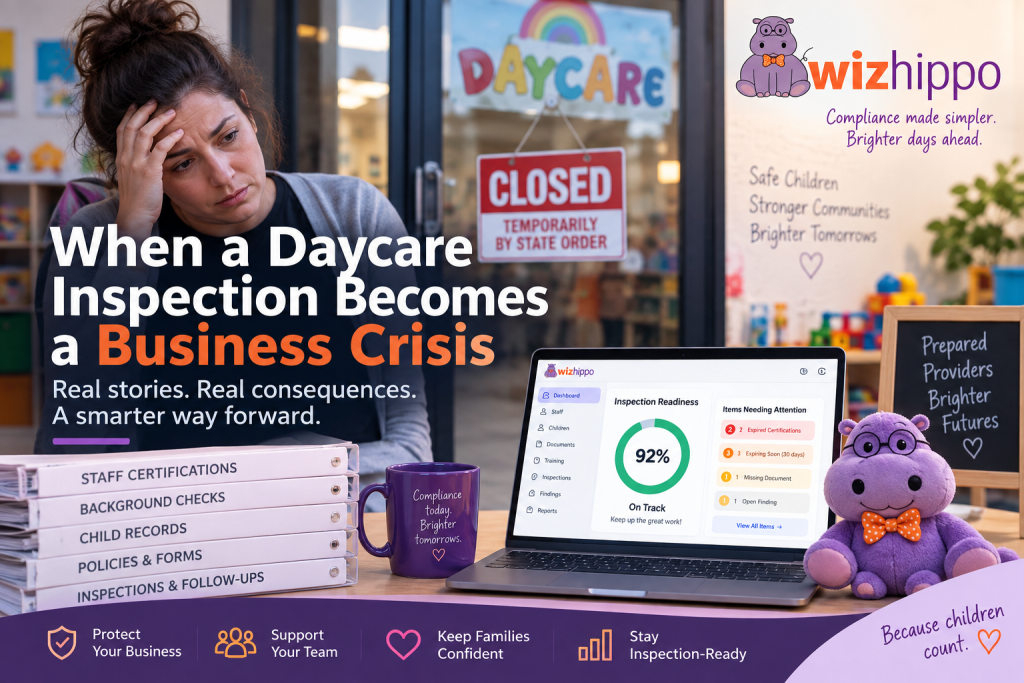
We built the platform because childcare directors already have too much to keep in their heads. WizHippo brings requirements, documents, staff training and certifications, child records, inspections, findings and follow-ups together so the program can continuously see where things stand.
The goal of the dashboard is not simply to produce a readiness percentage. Its real value is helping the director answer a practical question: What needs my attention now?
If most of the program is in good shape and three items need action, those three items should be easy to identify. If a certification is approaching expiration, the director should know before it expires. If something required is missing, there should be an opportunity to correct it before the next inspection turns it into a much larger issue.
What “inspection-ready every day” really means
When we say WizHippo helps childcare providers stay inspection-ready every day, we are not suggesting that directors should spend every day worrying about inspectors.
That would defeat the purpose.
A good compliance system should reduce that anxiety by keeping the important responsibilities visible while the director focuses on children, families, staff and running the program.
Inspection readiness should become the natural result of staying current, rather than a frantic project that begins when everyone suddenly realizes licensing may be coming.
The recent stories of childcare centers facing closures, public complaints and regulatory disputes demonstrate just how quickly the consequences can grow when something goes wrong. They also show the opposite: providers who know their programs are operating properly can face an unexpected inspection with much greater confidence.
No software can guarantee that a program will never receive a citation or become involved in a dispute with licensing. Regulations vary, people make mistakes and unexpected situations happen.
What a good system can do is help prevent the most frustrating kind of compliance problem—the one that was sitting inside the program all along and nobody realized needed attention until someone from outside found it.
For an owner who has spent years building a childcare business, that visibility is about more than passing an inspection. It is about protecting enrollment, employees, parent trust and the reputation that took so long to build.
An inspection may only occupy one afternoon, but the consequences of what it uncovers can follow a childcare business much longer. Finding a missing requirement while it is still an internal task gives the program options that may disappear once the same issue becomes an official finding or a public story.
That is why we believe the best time to know where your program stands is not when licensing arrives.
It is today.
The inspection is one day. The responsibility is every day.
Know what needs attention before inspection day
WizHippo helps childcare programs continuously monitor requirements, staff training and certifications, documents, child records, inspections, findings and follow-ups so directors have a clearer picture of where their program stands throughout the year.
Take the free WizHippo Inspection Readiness Check:
https://app.wizhippo.com/readiness-check/