Why staying inspection-ready takes more than a successful review—and how childcare centers and consultants can work together to make compliance part of everyday operations.
Running a childcare center means keeping track of hundreds of things that most families never see. There are enrollment records to maintain, staff qualifications to verify, training requirements to meet, health documentation to update, and safety procedures that need to remain part of everyday practice. All of this happens while directors and their teams are managing classrooms, supporting employees, communicating with parents, and caring for children. It’s a demanding environment, and even the most organized programs can find themselves struggling to keep up with the administrative side of compliance.
Many childcare providers invest considerable time and effort preparing for licensing inspections. Some work with experienced compliance consultants who review their documentation, identify potential problems, and help them understand what needs attention. Others handle these responsibilities internally, relying on binders, spreadsheets, calendars, and the knowledge they’ve developed over years of operating their programs. Regardless of the approach, the objective is usually the same: to make sure everything is in order when an inspector arrives.
But there’s an important question that often receives less attention: What happens after the review is finished and everyone returns to their regular routine?
The answer matters because compliance doesn’t stand still between inspections. An employee’s certification that was valid during the last review may expire next month. A child’s health record may need updating, a newly hired staff member may have outstanding documentation, or an emergency procedure may need to be reviewed. None of these changes is particularly unusual. They are simply part of operating a childcare program. The challenge is recognizing them early enough to take appropriate action, rather than discovering them when an inspection is already underway.
The Work That Happens After a Compliance Review
Imagine a childcare director who has just completed a thorough review with a compliance consultant. The consultant has examined employee and child files, discussed licensing expectations, identified documentation that needs attention, and offered recommendations for improvement. By the end of the meeting, the director has a clearer understanding of the center’s compliance situation and a list of items to address.
At first, everything seems manageable. A few documents can be requested immediately, several records need to be updated, and some follow-up activities can be scheduled for the coming weeks. Then the normal demands of running a childcare center return. A teacher calls in sick, a parent needs assistance, a staff member leaves unexpectedly, and the director spends much of the week solving problems that cannot wait.
A month later, some of the consultant’s recommendations have been completed, but others remain unresolved. Perhaps an employee submitted a training certificate that was never added to the correct file. A parent promised to provide an updated health form but hasn’t done so. An item that required follow-up was discussed during the review but never assigned a clear next step. Everyone intended to take care of these things, yet the information is now spread across emails, folders, notes, and individual conversations.
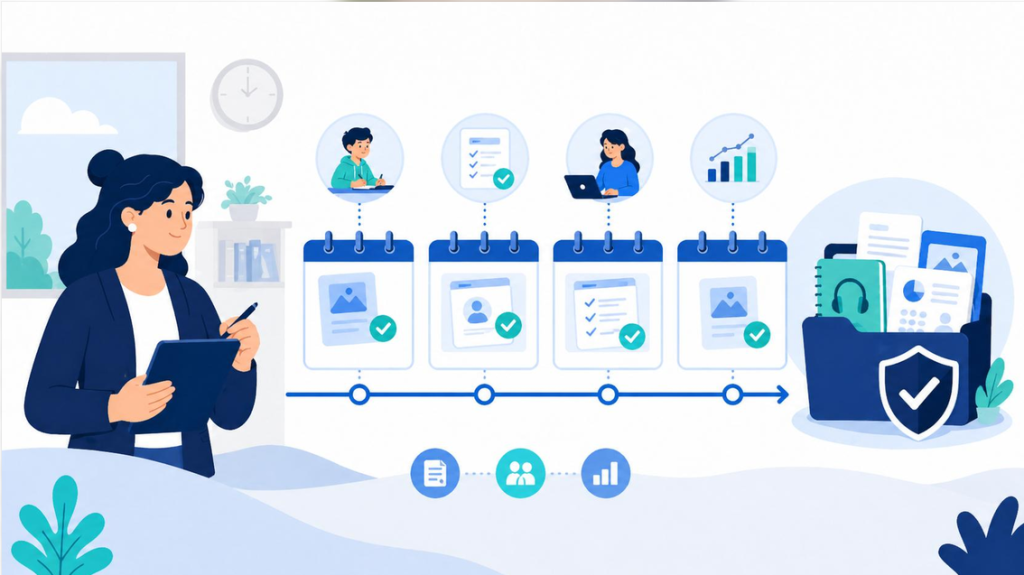
This is one of the less visible challenges of childcare compliance. Identifying what needs attention is only the beginning. Keeping track of the work until it is completed is what turns a review into lasting improvement.
That distinction is important because it changes how we think about inspection readiness. Instead of treating an inspection or consultant visit as the main event, we can begin to view it as one part of a continuous process. The review provides an opportunity to assess current conditions and identify improvements, but the real work continues in the weeks and months that follow.
Why Childcare Compliance Consultants Matter
Experienced childcare compliance consultants bring a perspective that is difficult to replace. They understand how licensing requirements are applied, recognize patterns that may not be obvious to a busy director, and help providers interpret expectations that can sometimes feel complicated or overwhelming. Their experience can be especially valuable when a center is responding to an inspection finding, preparing for a licensing review, improving its documentation practices, or developing more reliable internal procedures.
A good consultant does more than point out what’s missing. They help a childcare provider understand why something matters, what steps should be taken, and how to avoid similar problems in the future. That kind of guidance requires professional judgment, practical experience, and an understanding of how childcare centers actually operate. A software application cannot replace those qualities, nor should it attempt to.
At the same time, even the best consulting relationship faces a practical limitation. Consultants cannot be physically present at every center every day, and most childcare providers cannot afford to have someone dedicated exclusively to monitoring every administrative requirement. Between visits, the responsibility for maintaining records, meeting deadlines, and following through on recommendations remains with the center’s management and staff.
This creates an opportunity to think differently about how centers and consultants work together. Rather than limiting their collaboration to occasional reviews, they can establish a more consistent process for sharing information, monitoring progress, and recognizing potential problems before those problems become urgent. The consultant remains the professional advisor, while the center continues managing its daily responsibilities. What changes is the visibility each has into the work that needs to be done.
For consultants who support several childcare programs, this can also make their services more valuable. When they have a clearer picture of a client’s current compliance situation, they can spend less time reconstructing what happened since the previous visit and more time providing meaningful guidance. It also creates possibilities for ongoing support arrangements that extend beyond traditional inspection preparation or periodic file audits.
Making Inspection Readiness Part of Everyday Operations
Building a more reliable compliance process doesn’t necessarily require making childcare operations more complicated. In many cases, the greatest improvement comes from making existing responsibilities easier to see and manage. A director should be able to identify which staff certifications are approaching expiration, which child records still need attention, and which compliance-related activities are outstanding without having to search through several different binders or spreadsheets.
It also helps to establish a regular rhythm for reviewing this information. Rather than waiting until an inspection is announced, centers can set aside time to examine upcoming deadlines, check whether requested documents have been received, and revisit items identified during previous reviews. These check-ins don’t need to become lengthy administrative exercises. Their purpose is to prevent small oversights from gradually accumulating into larger problems.
For centers that work with consultants, the same approach can make collaboration more productive. Imagine a consultant who performed a file review six weeks ago being able to see which outstanding records have since been provided and which still need attention. Instead of beginning the next conversation with a lengthy reconstruction of what happened, the consultant and director can focus on the remaining issues, discuss priorities, and decide where professional guidance would be most useful.
None of this removes the need for staff accountability, accurate records, or sound professional judgment. Technology cannot determine whether every licensing requirement has been properly satisfied, and a digital checklist does not guarantee that a center is compliant. What a well-organized system can do is reduce the likelihood that important information will be overlooked simply because it was difficult to find, remember, or follow up on.
Ultimately, inspection readiness should be a reflection of how a childcare center operates throughout the year, not just how thoroughly it prepares for a particular visit.
Where WizHippo Fits Into This Picture
This is the challenge we had in mind when developing WizHippo. We wanted to make it easier for childcare centers to keep important compliance information organized and visible as part of their regular operations, rather than treating documentation and deadlines as something to revisit only when an inspection is approaching.
WizHippo brings together compliance requirements, supporting documentation, checklists, staff training records, and alerts for missing or expiring items. The goal is to give directors and administrators a clearer understanding of their center’s current situation, including what has been completed, what may need attention, and what is coming up. Instead of depending entirely on someone’s memory or a collection of disconnected tracking tools, centers have a more consistent way to monitor their responsibilities.
We also recognize that many childcare centers already have trusted consultants who play an important role in their success. We don’t see those relationships as something technology should replace. In fact, we believe the opposite: when centers and consultants have better ways to collaborate, professional guidance can have a greater impact.
That’s why WizHippo includes a Partner Portal that allows childcare consultants, with the center’s authorization, to connect with the programs they support and monitor relevant compliance information. A consultant can gain visibility into outstanding items and progress between visits, while the center continues managing its own records and daily operations. The intention is not to transfer responsibility away from the provider or substitute software for regulatory expertise, but to make ongoing collaboration more practical.
For childcare consultants and agencies interested in incorporating technology into their services, we also offer a dedicated WizHippo Partner Program. The free Advisor Partner option supports consultants who work with centers using WizHippo, while the Solution Partner option provides an opportunity to offer a branded platform as part of a consulting business’s services. Both approaches are built around the same principle: supporting the professional relationship between consultants and the childcare programs that depend on their expertise.
For childcare owners and directors, WizHippo can also be used directly, whether or not the center works with an outside consultant. The platform’s compliance tools are designed to help providers stay organized, identify potential gaps, and maintain better visibility into their responsibilities while they focus on the daily needs of their programs.
Beyond Passing the Next Inspection
When we talk about childcare compliance, it’s easy for the conversation to become focused on inspections, paperwork, and avoiding violations. Those things matter, but they aren’t the reason childcare regulations exist in the first place. Behind the documentation requirements, staff qualifications, health records, and safety procedures is something much more important: the responsibility that comes with caring for children.
Families place extraordinary trust in childcare providers. They expect their children to be cared for in environments where safety is taken seriously, staff members are properly prepared, and important responsibilities aren’t left to chance. Maintaining that trust involves far more than producing the correct documents when someone asks for them. It requires consistent attention to the practices those documents are intended to support.
Childcare consultants contribute to that responsibility through their knowledge, guidance, and experience. Directors and staff contribute through the decisions they make and the work they carry out every day. Technology can play a useful supporting role by helping everyone stay informed, organized, and aware of what still needs attention.
A successful inspection is certainly worth celebrating. But the more meaningful achievement is reaching a point where an inspection doesn’t require a week of panic, because the center has already developed reliable habits for maintaining its records, monitoring requirements, and addressing problems as they arise.
The real goal isn’t simply to be ready when an inspector arrives. It’s to maintain the standards that children and families depend on every day.
And that’s work that continues long after the review is over.
WizHippo helps childcare providers manage compliance requirements, documentation, and inspection readiness while supporting collaboration with the consultants who serve them. Visit WizHippo to learn about the platform, or explore the Partner Program for opportunities designed for childcare consultants and agencies.